Vietnam Open Touris

Hiển thị các bài đăng có nhãn Blackbucks. Hiển thị tất cả bài đăng

Indian savanna - Blackbuck National Park at Velavadar, Gujarat

 tháng 11 30, 2014     Bhavanagar, Blackbuck national park, Blackbucks, bluebull, flamingoes, Forest, Gujarat, Harrier, Hyena, Kaliyar Bhavan Forest Lodge, Nelgai, Velavadar, Velavadar national park, Wild cat, Wildlife, Wolf     No comments   

We wanted to begin this winter season with a forest trip. We decided to visit Velavadar national park forest which is famous for Blackbucks. Apart from Blackbucks, it is also famous for wolves, hyenas and migratory birds. Velavadar National park is also known as Blackbuck National park.

Travelers for this trip were me and wife Renuka.

At Velavadar

About Velavadar National Park, Gujarat:
Blackbuck national park is located in Bhal region of Saurashtra, around 42 km from Bhavnagar city. It is spread over an area of 34.08 sq. km, which is typically a grassland vegetation forest area. It was established in 1976.
          The sanctuary has been declared primarily for Blackbucks (Antelope species). You can see them in their natural mood, leaping high in the air, running, feeding, drinking, rutting and chasing. Apart from Blackbucks, other species found here are nilgai (blue bull), wolves, bustards, hyenas, lesser floricans, foxes, jackals and jungle cats. Velavadar is also a home to many birds like pelicans, flamingoes, ducks, waders, white storks, painted storks and sarus cranes etc. The Park is a heaven for demoiselle cranes, common cranes and a variety of raptors including spotted eagles and steppe eagles. The Park provides one of the world's best roosting sites to thousands of harriers that arrive here from Central Europe in winter.
         To reach here, you can take a train from Pune/Mumbai to Ahmedabad. Ahmedabad to Bhavnagar is well connected by rail as well as by road. Private bus service like Tanna and Rajdhani travels have regular bus routes from Ahmedabad to Bhavnagar.
If you are travelling by road then you need to take a right turn after Adhelai village.

We had total 4-5 safaris in the park in the privately hired car from Bhavnagar.

Blackbuck
BlackBuck in Action
View all the images in full screen for a better view!

Day 1: 28th Nov 2014 – Pune - Ahmedabad - Velavadar (Blackbuck National park)
             Our journey began on 27th Nov 2014. We boarded the Veraval Express train (Train No 11088) at 7.50 PM for Ahmedabad. Another option was Duronto Express but we didn’t get advance tickets however our return journey was by Ahmedabad-Pune Duronto train. After a 12 hour journey, we reached Ahmedabad by 7.50 AM.
             We went to Paldi area by auto for the further bus journey. We got seats in Tanna travels and the journey began towards the National park. Our Cab driver Kaushik Joshi was waiting for us at Adhelai village. By 12 in the noon, we reached Adhelai village. We were too hungry so we had our lunch on a roadside Dhaba and then went to Velavadar. Blackbuck National park (a.k.a. Velavadar National Park) is just 10km away from the highway. More than 40-50 demoiselle cranes and common cranes welcomed us on the way to the park. 

Common Cranes
Common Cranes 

Blackbuck
Male BlackBuck

Blackbuck
Who's There - Calf Blackbuck

            Quickly we checked in the guest house named Kaliyar Bhavan Forest Lodge. It is located inside the National park which offers you a magnificent view of the grassland vegetation along with blackbucks. There was no Non A/c room available while booking hence we booked A/C room. Advance booking is required and the process is a bit tedious as you are supposed to send a DD to book a room. The process to book the room and contact details are shared at the end of this blog post. The hotel is controlled by Gir Sasan forest department and rooms are very comfortable and clean.

Blackbuck
Mother and Calf crossing road

Blackbuck
Male Blackbuck
            
           After taking some rest, by 3 PM we took permit for Evening safari inside the forest area. Hiring a guide for every safari is compulsory. As our agenda in the park was photography and sighting of Wolf, Wildcat and hyena; we requested the forest officer to give us a good tracker. A guide named Vishal was appointed for us for next 3 days. Vishal was a perfect person for what we were looking for. He had a vast knowledge of the wildlife from Velavadar and was a very down to earth person. We 3 became very good friends after a few safaris.
            Forest department gave us bad news on day 1. Due to excessive grass cutting hyena families had vacated their territory and that was disappointing news for me as I hoped to see a few hyenas. Still, we (along with the guide Vishal) decided to give our best to spot hyena.

Nelgai a.k.a. Blue Bull

              The National park is mainly divided into two areas. One is Wetland area where you can spot many birds and mammals whereas the second area is grassland area where all mammals and harries can be easily spotted. We decided to start our safari with Wetland and then to visit grassland area for Harriers and carnivore species. The first animal that we came across was, of course, the Blackbuck. In hundreds! In the next three days, we wandered in the "National Park", we came across several large groups of Blackbucks. They seemed happy with so much food around and nothing much to disturb them except the wolf! Blackbucks are fast and are known to reach speeds of up to 80 km/hr.
           We saw many Blackbucks and wetland birds like greater Flamingo, White Pelican and many more birds. You can spot Eagles at the end of wetland area. After roaming for 2 hours in Wetland area, we came in grassland area to click Blackbucks in the evening light and to enjoy harriers. Velavadar Park is also famous for being the largest site for roosting harriers, i.e. in winters; thousands of harriers roost here by dusk and fly out in search of food by dawn.

Indian Spotted Eagle

White Pelican
White Pelican

kestrel
kestrel

Pallied Harrier
Pallied Harrier

              We were about to end our day; hence we started with our return journey to forest guest house. All of sudden we saw more than 400 blackbucks crossing the road. Vishal asked us to keep an eye on the grass as the blackbuck might have seen Wolf or hyena. We waited till all crossed the road but couldn’t spot the wolf. We were back in the car and resumed the further journey. Suddenly gorgeous looking Wolf came in front of the car from the grass. The Wolf is the main predator in the area and Striped Hyena often steals a kill from the wolf. I was unable to capture him in my camera but it was an amazing experience to watch a Wolf with hardly 10-12 Ft away from us.
           We had dinner by 7.30 PM at the guest house. Apart from us, only 4 people were staying in the guest house. We meet them to discuss the sighting in the forest. It was really nice meeting young enthuse new friends of age 40 to 60. We spend 2 hours with each other talking about wildlife and photography; it happens when like-minded people meet.

New Friends

Expenses:
  • Pune-Ahmadabad train ticket: INR 700/- (Sleeper coach for 2 people)
  • Auto to Paldi area from railway station: INR 70/-
  • Lunch: INR 200/- for 2 people on highway side dhaba
  • Safari entry permit: INR 200/- for car
  • Safari guide: INR 100/-
  • Camera chargers for safari: INR 200/- for 2 SLR camera
  • Dinner (Veg meal): INR 300/- for 2 person

Day 2: 29th Nov 2014 – Velavadar (Blackbuck National park)
The park opens at 7 AM. We were ready along with Vishal by 6.30 in the morning. We decided to spend more time in wetland area as chances of spotting a wolf was high. We spend around 2.5 hours but were only able to see birds, Blackbucks and Nilgai. To some extent, we saw few wild boars closely. We left this place after the good sighting of wildlife and went in the grassland area. After enjoying the sight of blackbuck’s activity in grassland and few harries (Usually Harries fly out in search of food in nearby farms area and return to park area for roosting) we decided to give one more chance to spot a wolf in another part of the park.

Nelgai
Male Nelgai

Female Nelgai
Miss Nelgai

            We again went to the wetland area in search of a wolf. We took the rightmost route which is parallel to a small river stream. Here we saw albino blackbuck. Entire white colour blackbuck is known as Albino blackbuck and that colour appears due to some skin disease. On the other side of the small river stream, we saw many blackbucks crossing river stream with high speed. Now we started searching for the predator that had scared them. Without wasting much time, we spotted the royal entry of a wolf. Generally, wolves prefer hunting in groups but this wolf was in the mood of hunting alone. We saw his 3 failed attempts at hunting small blackbucks. It was really memorable movement. After his unsuccessful attempts, he gave up and took rest under a tree. Soon he crossed the water stream and went inside grassland. We were lucky enough to follow him for around 40min. Our morning safari was fabulous.

Green bee eater
Green bee-eater

Montagu's Harrier
Montagu's Harrier

Blackbuck fight
Blackbuck fight

Running Blackbuck
I saw Wolf...Run fast

Prey and Predator...Wolf and Blackbuck

Run fast....Blackbuck in Velavadar
Run fast...Blackbuck in Velavadar

Wolf after 2 Failed attempt of hunting Blackbuck's Calf

             We came back to the guest house for lunch and took rest for an hour. By 3 PM, again we left for evening safari. By now we had seen wolves twice, but unable to spot hyena and Wildcat. We decided to focus more on Wildcat as hyena was rare to spot. Evening Safari was quite disappointing as we unable to spot any predator. We only enjoyed Blackbuck and birds from the park. In the evening we met our friends inside the park and shared our contact details with each other. They left Velavadar by 6 PM. It was really nice meeting Arvind Sing, Suru Nair, Rahul Bhagwat and Subhash Bhagwat. Hope will meet soon in the forest again. 

White Pelicans
White Pelicans 

Grey PARTRIDGE
Grey PARTRIDGE

Small kingfisher.
Small kingfisher...Ready for catch

We had tasty food and slept soon in the hope to spot at wildcat and hyena tomorrow.

Veg meal
Veg meal

Expenses:
  • Morning Safari entry permit: INR 250/- (INR 50 extra on Weekend hence INR 250/-)
  • Safari guide: INR 200 for entire day
  • Camera chargers: INR 400/- for entire day for 2 SLR camera
  • Lunch (Veg meal): INR 300/- for 2 person
  • Evening Safari entry permit: INR 250/- (Weekend rate)
  • Dinner (veg meal): INR 300/- for 2 person
  • Coffee: INR 7/- per cup

Day 3: 30th Nov 2014 – Velavadar (Blackbuck National park) - Pune
Our Morning safari began at 7 AM. Today we decided not to visit Wetland area and just look for the predator in the grassland area of Velavadar Park. We spent 3 hours but were unable to spot those 2 predators. By 10 AM, we gave up and decided o leave the forest. We were supposed to start our journey towards Ahmedabad to catch Duronto train. Our guide Vishal was feeling bad that we were unable to spot wildcat and hyena. Just to give a last try, he called another guide who was inside the forest with another tourist. We got to know that they spotted wild cat around an hour ago. There was a thin chance to spot it again. I asked him to take us on that route as Cat family mammals are quite lazy and they spend more time in the same area.

Wild boar
Wild boar

Morning Walk is good for health...Male Blackbuck

Blackbuck Jump
Calf Jump

               Our search operation began with enthusiasm and hopes. We went until the end of that route but no sighting. Our eyes were on grassland and suddenly I saw a brown colour tail with a black ring at the end of the grass. I tapped on Vishal’s shoulder and said I spotted her, there is she. We then stopped our vehicle slowly and the wildcat was just 5-6 Ft away from us. As she was in the grass so I didn’t get proper photos. We waited for few minutes and she came out from the grass, crossed the road quickly and disappeared in the grassland. Fortunately, there was a watchtower on the grassland side. We climbed the tower and searched her. Due to the color of grass and the cat, it was difficult to find her. Finally, we saw her and manage to click few photos. I had waited such a long time for this moment! Wow, what a relief that we saw all the mammals from forest expect hyena. 

Wild Cat look
Wild Cat look

Search Wild cat in this picture in 5 seconds... Perfect example of Camouflage
Search Wildcat in this picture in 5 seconds... Perfect example of Camouflage

While returning to the room, we saw a wolf again (3rd time) but it was far away from our vehicle. We came back to the room and packed our bags. Before leaving the forest area, we visited the museum located in the forest. It has a nice photo collection and information about the forest and the species. Overall it was truly an amazing trip. We were not feeling bad as we couldn’t spot hyenas as its pure luck and we can’t control the nature. Maybe it was a sign for us to visit this savanna forest again for hyena and peace.

Guide Ramjan, Guide Vishal, Me and Renuka (From L to R)

Time to say Bye to Beautiful Velavadar

              We hired same the vehicle until Ahmedabad. We had lunch on the highway and reached Ahmedabad by 4 PM. As we were having some time, we visited the Gandhi Ashram, Sabarmati riverfront and Kankaria Lake. We boarded Duronto train by 10.20 PM and reached Pune safely by 7.15 AM

Expenses:
  • Morning Safari entry permit: INR 250/-for car (weekend rate)
  • Guide chargers: INR 100/- for the morning session.
  • Camera charger: INR 200/- for 2 SLR camera
  • Car rent for forest safari + drop to Ahmadabad: INR 7000/-
  • Lunch on highway side dhaba: INR 300/-
  • Local day Bus ticket: INR 50/- (30 for men and 20 for woman)
  • Kakaria Lake entry fee: INR 20/- for 2 person
  • Coconut water at Gandi ashram: INR 40/- per coconut (costliest coconut water I had ever in India)
  • Snacks such as chats, Dabeli: rate as per ordered dish.
  • Dinner at Lake Side hotels: INR 160/- for 2 person
  • Ahmadabad-Pune Duronto train ticket: INR 2260/- for 2 people in 3AC coach 

The process to book Kaliyar Bhuvan guest house at Velavadar Park:
  1. Contact to Forest department, Bhavnagar for booking on 0278-2426425.
  2. If room is available then block/book a room by providing them travellers name and contact details
  3. Create a DD by name “RFO Velavadar ” 
  4. Fax the DD copy to Bhavnagar office (Fax number: 0278-2426425, Same as contact number)
  5. Send DD to mentioned address: Assistant conservator of forest, Blackbuck national park, Bahumali Bhavan, Annex building, Block no S-10, forest department, Bhavnagar 364001, Gujarat
  6. After 5 days check whether the room is booked by your name or not.
  7. They do not provide acknowledgement receipt in advance so better to cross-check on phone about booking and carry a photocopy of DD and ID proof on the trip.

Contact details from Velavadar:
  • Blackbuck National park, Bhavnagar office: 0278-2426425
  • Car on Rent from Bhavnagar: Kaushik bhai joshi 0-9426461814, 0-9099553585
  • Vishal Zapadia, Guide/forest Tracker in National park: 0-9978770156. (Most experience guide after Ramjan but very enthusiastic person) 
  • Ramjan khan, Guide/forest Tracker in National park: 0-8140810087. (Most experience guide from Park)

Some more Clicks


European Roller
European Roller with broken beak... how he survives but the fact is he does

Parrot
Parrot
Albino Blackbuck
Albino Blackbuck
Blackbucks crossing...
Blackbucks crossing...whereas 2 young Blackbuck were watching us.

Male Blackbuck
Male Blackbuck

Young blackbuck
Look at me...Young Blackbuck 

All rights for images reserved and required prior permission to use.

Thanks for reading this Travel Blog. 
Happy traveling.

Pritesh Kulkarni 

Pune
Read More
  • Share This:  
  •  Facebook
  •  Twitter
  •  Google+
  •  Stumble
  •  Digg

Trip to Glorious Ellora – Ajanta and Aurangabad

 tháng 10 30, 2014     Ajanta, Ajanta Caves, Ajintha, Aurangabad, Bibi ka Maqbara, Blackbucks, Daulatabad fort, Devagiri, Ellora, Ellora caves, Gautam Buddha, Grishneshwar, Jayakwadi, Kailasanatha temple, Manjari village, painting     No comments   

After a beautiful Coastal trip to Ratnagiri and nearby area, we decided to visit the Ajanta and Ellora Caves. These 2 sites were on my travel wish list for a long time. Considering Diwali holidays, we planned a 4 day trip to Ellora – Ajanta and Aurangabad.

Travelers for this trip were Me, Renuka and my parents-in-law.

Ajanta Caves, Wonder of India

About Ellora – Ajanta caves and Aurangabad:
                Aurangabad is the 5th largest city in Maharashtra state. It is named after the Mughal Emperor Aurangzeb. It is also famous as a tourism hub as many historical monuments are close to the city. It includes UNESCO World Heritage Sites such as Ellora – Ajanta caves, Bibi Ka Maqbara, Jayakwadi Dam and many more places.
              Ellora and Ajanta Caves are located 30km and 110km away respectively from Aurangabad. Ellora consists of 34 "caves" that are actually structures excavated out of the vertical face of the Charanandri hills. Buddhist, Hindu and Jain rock-cut temples and viharas and mathas were built between the 5th century and 10th century. Ajanta consists of 30 rock-cut Buddhist cave monuments which date from the 2nd century BCE to about 480 or 650 CE. Carvings and paintings inside the caves are the masterpieces and clearly, indicate why these are UNESCO World Heritage Sites. The Ajanta caves are cut into the side of a cliff that is on the south side of a U-shaped gorge on the small river Waghur. 

The route to reach Aurangabad from Pune is –
Pune – Take road behind Pune station - Yerawada Bridge – Take right after crossing the bridge for Nagar Road – Drive on highway No 27 – Ahmednagar – Aurangabad.
The route to reach Ellora caves from Aurangabad is – 
Aurangabad – Aurangabad cantonment area – Daulatabad (Visit daulatabad fort) – Khuldabad – Do not take a right for kuldabad - Ellora Caves
The route to reach Ajanta caves from Aurangabad is – 
Aurangabad – join State highway 8 – Phulambri – Sillod – Ajanta Caves

Our stay was at our (Me and Renuka) best friend Ashu’s house which is in a small village called Manjari. Even though the village was small, their house was of Wada type with huge acres of farm land behind the Wada. Manjari village is hardly 35km away from Aurangabad city.

Day 0: 25th Oct 2014 – Pune - Manjari village (Total Distance travelled: 214 km):
               It was the last day of the Diwali festival i.e. Bhaubeej. After celebrating this day with relatives, we left Pune by 4 PM. Our target was to reach Manjari by 8.30 PM and take rest. Ashu’s uncle who is also fond of travelling joined us for next 4 days.
               The drive till Ranjangaon was a bit difficult due to heavy traffic. After crossing Ranjangaon, it was a smooth drive till Manjari. Due to some cyclone on the west costal area, the weather was cloudy and rain accompanied us till Aurangabad which made us our journey more pleasant. We took a pit stop at a town called Super for snacks and reached Manjari by 9 PM. 

Stay at Manjari Village

Expenses:
  • Car Petrol: INR 3000/- (approx. 40 lit at 76/Lit)
  • Toll 1: INR 45/- (single journey)
  • Toll 2 (at Nagar): INR 30/- (single journey)
  • Toll 3 (at Khadka): INR 30/- (single journey)
  • Snacks at supe: INR 90/- (Vada Pav and tea)

Day 1: 26th Oct 2014 – Manjari – Daulatabad – Ellora - Grishneshwar (Total Distance: 300 km):
           We woke up a bit late by 7 AM, spent some time with friend’s relatives. After breakfast, we left for a day trip by 9.30 AM. It was a lazy start for our trip. Our first destination was Daulatabad Fort. After 45-50 km drive, we reached the parking area of the Fort. Daulatabad fort is a 12th-century structure situated about 15 kilometres from the city of Aurangabad.
            It was built in the 12th century by the Yadava King of Bhillima V and was called Devgiri. Devagiri was also known as “Devgad”, “Surgiri” and “Dhargiri”. Then, it was acquired by Alauddin Khilji who made it a Mughal stronghold. In the early 14th century, Sultan Mohammed-bin-Tughlak, moved his capital from Delhi to Devgiri and renamed this fort city as Daulatabad. Fort consists of multiple layers of massive walls, deep water trench around the fort, and complex arrangement of entryways for a strong defence.

Information Board

             After crossing the entrance gate, you can see strong walls with guard rooms and different types of cannons kept for display. The arrangement of the entrance is in such a way that any enemy entering the gates is subject to attack from all sides. The walls surrounding the main entrance gate are still in good shape. After crossing the entrance structures, we took a walk towards the main fort area. On the left side of the walkway, you can see huge water tank known as Hatti Talav (meaning, Elephant Lake). This artificial lake is 38 meters long, 38 meters wide and 66 meters deep. Due to the hugeness, it is known as Hatti Talav. This might have been the main source of water for the entire fort.
             There is a very beautiful temple at the back side of Lake, known as “Bharatmata” temple. It is dedicated to mother India. The courtyard of the temple doesn’t have a typical roof but consists of many beautiful sculptures. This temple looks like it is from the ancient time of ‘Yadavas’. There is a big statue of “Bharatmata” inside the temple. Pillars inside the temple are carved in such a way that they are in the same line and of the same size. The beauty of the temple can be seen only after entering the temple premises. 

Bharatmata Temple, Daulatabad Fort

           On the right side of the walkway, there is four stage 100 meter height tower known as Chand Minar. It is said that Sultan Ahmed Shah constructed this tower to commemorate the victory over Gujarat. It is prohibited to enter this tower. After crossing Minar, you come across the first gate with strong bastions at both the sides. Climb on fort starts from this point. Nice stone steps are laid till the topmost point of the fort. You can see the second gate known as Dindi Darwaja, Chini Mahal which was used for keeping prisoners on the fort and a cannon called as “Mendha Tof”. 

Chand Minar
Chand Minar

              Next attraction on the fort is the Moat (deep, wide ditch surrounding a castle to defend against attack) around the fort. There are 2 bridges on the Moat for crossing. One is an Iron Bridge (Later constructed) and another old one made up of stone at a lower level. The trench was made in such a way, that if the enemy enters the main wall, the moat was filled with water enough to drown the rock bridge. The trail after crossing the bridge takes us to the third entrance which can hold a maximum of 10 to 12 people. After this, you can see the entrance to a cave known as Dark maze. A narrow path in the maze is created in such a way that the enemy can get confused and finds it difficult to move ahead. There are small windows on the roof which were used to release smoke of hot chillies and oil into the tunnel by keeping a hot pan at the top of the tunnel. There is no light source in the tunnel whereas second part has some light connections. After crossing the tunnel way and few steps, you can reach the top. At the top, an extensive octagonal building called as ‘Bardari’ can be seen. The balconies of the palace offer you a view of fort and Daulatabad town. The right side door of the palace takes you to the top-most point of the fort. 

Moat of Fort

Dark Maze
Dark Maze, first half of maze w/o light on left whereas second part on right with light source

Palace on top
Palace on Top

               After crossing Bijali Darwaja, a big bastion can be seen. This bastion has a cave within it. It consists of a water tank and footprints of “Janardan Swami”. At the topmost point, there are a 20 ft. long cannon named as “Durga” or “Dhuldhaan”. It was very difficult to conquer such invincible, inaccessible and strong fort.

Durga or Dhuldhaan Cannon

             After visiting such a massive fort, our next destination was Ellora Caves. We had lunch at a roadside dhaba and reached Ellora caves. The Ellora Caves are located about 28 km from the city. The actual name of Ellora cave is Verul but it was difficult to pronounce for the British and thus was renamed as Ellora. The main attraction in Ellora cave is Kailashnatha Temple. The Kailashnatha Temple is cave number 16 amongst the 34 caves of Ellora. Building the Kailasa temple self-consumed around 200 years to complete. Apart from the grand Kailashnatha Temple, there are 33 rock-cut caves in all at Ellora; some breathtaking and some that could be bypassed. Of the 34, 12 are Buddhist caves, 17 Hindu and 5 Jain caves. It is recommended that you must visit cave numbers – 10, 11, 12, 15, 29, 31, 32 and 33. The Buddhist caves are rich in paintings and iconography. Cave 10 represents a Buddhist Chaityagriha (prayer hall). 


Information board

The Kailashnatha Temple

              Due to lack of time, we saw cave number 16, 15, 18 and 29. This temple is a remarkable example of Dravidian architecture on account of its striking proportion; elaborate workmanship, architectural content, and sculptural ornamentation of rock-cut architecture. The Kailasa Temple is notable for its vertical excavation—carving started at the top of the original rock and excavated downward. After entering in Kailasa Temple, we took a left side path to see the entire temple. There are 2 pillars (Dhwajasthambha) in the courtyard. Also on the wall of the temple, you can see the story of epic Mahabharata carved beautifully. Surrounding walls have beautiful carvings which are at more than one level. A two-storied gateway opens to reveal a U-shaped courtyard. Carving, sculpted panels on walls tell you stories related to Ramayana, Mahabharat, Lord Vishu and Lord Shankar. Temple premises consists of two structures; one is Shiva temple and second is Nandi Mandapa. A rock bridge connects the Nandi Mandapa to the porch of the temple. It takes around 2 hours to see an entire temple in detail. 

War story of epic Mahabharata

Dhawjasthambha, Temple and Nandi Mandapa

            After the temple visit, everyone took rest when I hiked on the mountain to capture an aerial view of Kailasanatha temple. View of entire temple and garden in front of caves is breathtaking. Other important caves in Ellora are Cave number 1, 2, 10 (Vishwakarma cave), 11 and 12. In Buddha caves, you can see restrooms, Vihar, chaitya (prayer hall) and Stupas (place of meditation). 

Temple view from hill

Sculpted panels on wall - stories related to Ramayana, mahabharat, Lord Vishu and Lord Shankar
Few Sculpted on wall - stories related to Ramayana, mahabharat, Lord Vishu and Lord Shankar

             After visiting the magnificent Ellora caves, we went to Grishneshwar. This temple is small in size but always crowded. It is the 12th Jyotirling temple dedicated to Lord Shiva. It is close to Ellora caves. The temple is built in Red Rock. You cannot carry leather material, camera and mobile inside the temple. Photography is not allowed. We quickly took Darshan and left for our last destination. Our last destination for the day was Badra Maruti temple located in Kulatabad. It is of sleeping Lord Maruti. Temple is clean but surrounding area is not at all maintained. Again Photography is not allowed in the temple.
               By 7 PM we started our return journey and came to Manjari village by 8.30 PM. We celebrated Diwali with small kids from the village by lighting sky lanterns.

Expenses:
  • Toll near Aurangabad: INR 45/- (return journey)
  • Daulatabad fort entry: INR 5/- per person
  • Daulatabad fort video camera chargers: INR 25/- (No fees for Camera)
  • Car parking at Verul (Ellora Caves): INR 10/-
  • Ellora Caves entry fee: INR 5/- per person
  • Ellora Caves video camera chargers: INR 25/- (No fees for Camera)
  • Car parking at Kulateshwar Temple: INR 10/-

Day 2: 27th Oct 2014 – Manjari – Jayakwadi Dam – Aurangabad (Total Distance travelled: 290 km):
               Our today’s target was to visit Jayakwadi Dam for bird watching and then some tourist spots from Aurangabad city. We woke up by 5.30 AM and left the village by 6.15 AM. After an hour drive, we reached near the Dam area. Road condition was quite poor whereas roads nearby Dam area was in terrible conditions.

Jayakwadi Dam

              Unfortunately, we were not able to spot any birds on the water body. Either migration season had not yet started or we were at the wrong side of Dam. While driving towards Paithan if you keep a watch on the right side there is a Bird sanctuary board (near Dalwadi village). Take right and drive towards the wall. A watchtower is constructed to spot birds from the water bank. We saw few birds and then drove towards open jail area. We were able to see few local migratory birds such as Open bill Asian stork, white Ibis, black ibis, glossy ibis, grey heron etc.

Open bill Asian stork and Ibis

               By 10 AM we went to our next destination Paithan. We saw Sant eknath temple where he took Samadhi. After our quick visit to Paithan town, we left for Aurangabad sightseen. We had tasty lunch at hotel Abhiruchi on Paithan - Aurangabad road. 

Sant Eknath Temple
Sant Eknath Temple

            In Aurangabad, our first destination was Panchakki (Watermill). This mill was designed to generate energy via water brought down from a spring on a mountain. It was built in 1744 to commemorate Hazrat Baba Shah Musafir, a religious teacher who had emigrated all the way from the Russian town of Gazdavan. It was used to grind the grain for the pilgrims. A large size water tank is not maintained properly and it has many fishes. There is nothing much to see as tourist other than old Panchakki. 

Panchakki

               Our next and last destination for the day was Bibi ka Maqbara. It is a most recognized monument of Aurangabad city. The Bibi Ka Maqbara was built by Azam Shah, the oldest son of Aurangzeb. This was his attempt to rival the Taj Mahal built by his grandfather, albeit in memory of his mother, Rabia Durrani, the first wife of Aurangzeb. One of the striking features of Bibi Ka Maqbara is its resemblance with the Taj Mahal in Agra in terms of design. It is often called the Deccan Taj or the Taj of the Deccan. 

Taj Mahal, Agra
Taj Mahal, Agra (Photo taken in the year 2009)

Bibi ka Maqbara
Bibi ka Maqbara

             People who have seen Taj Mahal may find this place quite average. I have seen Taj Mahal and Bibi ka Maqbara is just a poor replica of Taj. But still, the structure is very beautiful and white marble is used for construction. Bibi ka Maqbara follows the charbagh (literally meaning four gardens) layout which was a common element in Mughal architecture. 

Way towards Bibi ka Maqbara

              Construction of the Taj Mahal was completed in 1653, while the Bibi Ka Maqbara was built sometime between 1651 and 1661. It is said that while the Taj Mahal was built at a cost of approximately 32 million rupees, the amount allocated to Azam Shah for the Bibi Ka Maqbara was a paltry 7 lakhs. Azam Shah’s only claim to fame is the Bibi Ka Maqbara. He was the son of Aurangzeb, but he was Emperor of India for a very short time – a period less than three months! He declared himself emperor after the death of his father, but within three months, he was defeated and executed by his brother, Shah Alam.
             We heard from many tourists not to hire any guide as they charge you between INR 50-100/- and tell you the above story in just 3-4 minute. After Bibi ka maqbara, we spent some time in the city to see marketplaces and different gates. Aurangabad is titled as "The City of Gates" and the strong presence of these can be felt as one drive through the city. By evening time we came back to Manjari village and spend the remaining time with our friend and her family.

Expenses:
  • Toll near Aurangabad: INR 45/- (return journey)
  • Toll near Paithan: INR 40/- (return journey)
  • Lunch at Abhiruchi hotel: INR 638/- for 5 people (Papad, Panjabi veg, roti and rice)
  • Entry at Panchakki: INR 5/- per person
  • Car parking at bibi ka Maqbara: INR 10/-
  • Entry at Bibi ka Maqbara: INR 5/- per person
  • Bibi ka Maqbara video camera chargers: INR 25/- (No fees for Camera)

Day 3: 28th Oct 2014 – Manjari –Ajanta Caves – Manjari (Total Distance travelled: 350 km):
              We woke up by 6 AM and left Manjari village by 7.30 AM for Ajanta caves. The distance of Ajanta from our location was around 170-175km. Without any pit stop, we headed towards Ajanta caves. Road condition was average. We took a lunch break by 11.30 AM at a dhaba which was viewpoint junction of Ajanta caves. We reached Caves parking area by 12.30 PM. From this point, you need to board on MTDC’s buses that take you to the base point of Ajanta caves. Distance is around 4 km and the road goes through the very dense forest with some curvy roads around hill region. No prior booking is required for MTDC’s bus service and Caves are closed on every Monday.
              We got the bus quickly and reach Cave’s base point. After purchasing entry tickets, I was in hurry to see the magnificent wonder named Ajanta caves. From this point, you need to climb steps to gain a height. After certain height gain, I saw beautiful Ajanta caves, excavated in a horse-shoe shaped rock surface about 77 meters in height overseeing a narrow stream known as Waghora. Entire cave sight was simply incredible and I was happy to see what I had come so far to see.

Ajanta Caves
Ajanta Caves, Entry towards first Cave

               It is a phenomenal place as Caves are built over 2000 years ago, in second century BC. Most recent caves were dug out of rock in the 9th century AD. History says that this mountain region was ancient Deccan trade route to the sea and these caves were a house of the Buddhist monks as well as a place for traders/pilgrims to take a rest during monsoon time. I can almost imagine them walking barefoot through the dense forests, unaware of the dangers, seeking a place on such a cliff where they could find peace. These people were great explorers and must be great artists, excavating, carving and painting the caves as beautifully as they did. 

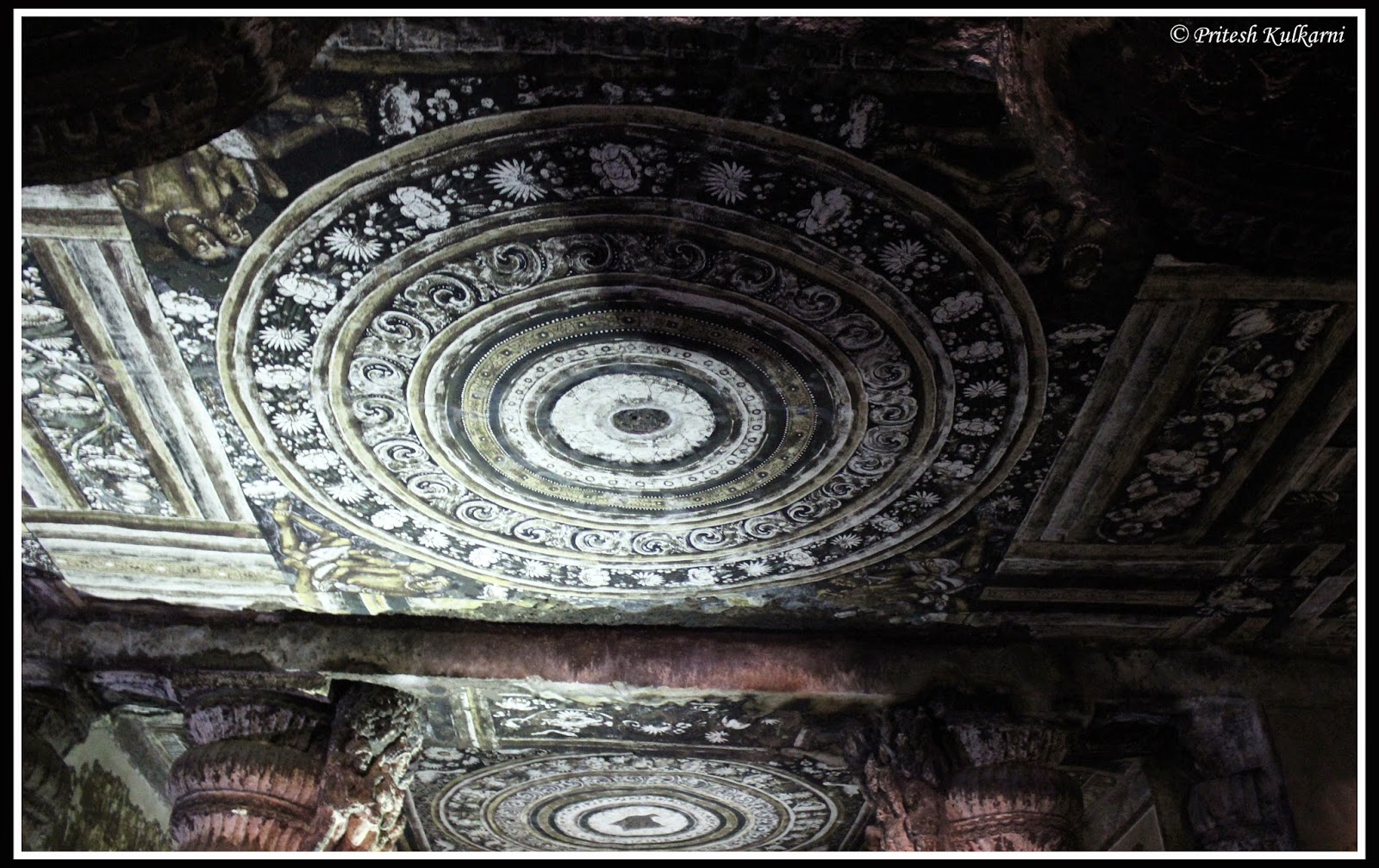
Painting on Ajanta Cave's roof
Painting on Cave's roof

Carving and painting at Ajanta Caves

              British officer John Smith on a hunting mission accidentally rediscovered these caves in 1819. There are 29 to 30 Caves and few of which are unfinished. The caves are numbered 1 to 29 according to their place along the path. The caves were dug over two periods – the first set around the 2nd century BC, during the reign of the Satavahanas. The earliest group of caves consists of caves 9, 10, 12, 13 and 15A. In these caves, we can see Stupas representing the Buddha, but not figures. The paintings represent stories, especially from the Jataka Tales. The second sets of caves were excavated somewhere between 6th to 7th centuries AD, during the reign of the Vakataka kings. Second phase Caves are more focused on buddha’s life which is now known to the world. It also consists of Vihar, chaitya (prayer hall) and Stupas (place of meditation). Paintings in caves were very old but still masterpiece art. Even after so many years the colours still look fresh and each painting conveys a story to you. 

Gautam Buddha
Gautam Buddha

            Once you enter the Ajanta caves area, Cave number one is on your right side and all others are sequenced accordingly. The paintings seen in the interiors and exteriors of the caves include different images. These images are Great Buddha, a Goddess on the upper left corner of the shrine doorway, a Bodhisattva believed to be Padmapani Avaokitesvara, Four Deer with a Common Head, Lovers, a Dark Princess believed to be an Andhra Princess, a Dancing Girl with Musicians, a Princess Reclining by a Pillar, a Maid seated on the Ground, Proceedings in a Persian Court, the Golden Geese, the Pink Elephant, a Bull Fight, etc. 
            Cave 6 is believed to be the first important cave of the Mahayana phase. It comprises of a central pillar in the lower story, along with an image of seated Lord Buddha. Cave no 7 consists of the beautiful painted ceiling and simple carving. Cave number 9 and 10 are Chaitya Gathering Hall. One of the most impressive images seen inside cave number 18 is that of a princess looking at her mirror, with a child looking at her from below. You can see rest cells inside caves meant for rest. 

Stupa

            Do not miss Cave number 26 of Sleeping Buddha. This Cave was chaitya hall with Stupas in it. Painting of small Princess on pillars has its own speciality. If you look at the painting from any direction still it gives you a feeling that same princess is staring at you. Spending 4 hours in Ajanta world, we started with our return journey. After crossing the bridge on the river, we saw a waterfall which was at the end of the horse-shoe shaped mountain. 

Sleeping Buddha at cave no 26

Princess painting on pillar (Staring at you from any direction)

Same Princess painting on pillar from other direction (Staring at you)

Ajanta Caves
Ajanta Caves

            I wanted to see entire Ajanta caves from a height. There is a viewpoint location which is just opposite to caves. To reach this point, you need to climb few steps. I alone went there as others were tired. From this point, you can see entire Caves in 120-degree view. I wondered what happened in past that made the monks disappear from Ajanta. Some caves have been left unfinished. The answer to this question was unknown. The only thing we do know is that Ajanta was abandoned and the caves were hidden by nature till the British officer found his way there. After capturing this moment, I came down to catch the bus. This place is simply fabulous and everyone should visit this once.

Waterfall on Waghora River

Ajanta Caves from view point
Ajanta Caves from viewpoint


We started our return journey and took dinner at Ludhiana hotel on Aurangabad – Nagar highway. It was a perfect day for our vacation. 

Expenses:
  • Toll on Ajanta route: INR 40/- return journey
  • Car Petrol: INR 2000/- (approx. 27 lit at 73/lit)
  • Lunch at dhaba: INR 750/- for 5 person
  • Ajanta Car parking: INR 30/-
  • Ajanta person tax: INR 10/- per person
  • Bus service till Ajanta Caves: INR 15/- per person
  • Ajanta Caves entry: INR 10/- per person
  • Ajanta Caves light chargers: INR 5/- (for group of 20 people)
  • Ajanta Caves video camera chargers: INR 25/- (No fees for Camera)
  • Bus service to Ajanta parking: INR 15/- per person
  • Dinner at hotel Ludhiyana on Aurangabad-Manajari highway: INR 520/- for 5 people

Day 4: 29th Oct 2014 – Manjari –Pune (Total Distance travelled: 220 km):
             Today was our last day of vacation. Our stay was at a friends place in the small village and they own more than 100 acres of farming land behind their house. Also, they were having an additional huge acre of farming land which was just 5 km away from the village. We were aware of one fact that many groups of deer’s and blackbucks can be spotted easily on the farms. It was the best opportunity for me to capture them in my camera. It was in my mind from day one.
              Without any kind of alarm, I woke up by 6 AM and was set for photography. Ashu’s brother and uncle were ready with 2-3 bikes as after certain point it wasn’t possible to go ahead by car. After few minute’s drive, we reached on a farm. With the help of binocular, we spotted a group of deer and blackbucks. I went to the farming area and clicked few shots. That group was small hence I was not satisfied. Prashant kasale (my friends young enthuse uncle) asked me to join him for more blackbuck sighting. We both went 2-3 km in a different direction and saw 30-40 blackbuck. Wow, it was a great moment for me to click them. Without disturbing them I manage to click few shots. These animals are a problem for farmers as they destroy farms during their internal fight. Group of farmers from other side came towards blackbucks and the beautiful animals ran away.

Blackbucks
Look at Me...Blackbucks 

Blackbuck in action
Blackbuck in action

            While returning to the village, we saw a group of 50 blackbucks running from one end to another. I realized that it doesn’t move ahead then they will cross the road just a few ft. away from us. We parked the bike near bushes and sat down on road. Within few minute they crossed the road. To capture them while jumping was a different experience for me.

Let's Run...Blackbucks

Blackbucks
Stop...Blackbucks are crossing the route

Long Jump or high jump...Blackbucks crossing road

            We came back to the village and spend some time with the relatives. After breakfast, we left for Pune journey. On the way to Pune, we took a small break at Devgad village which has a nice temple of Lord Datta. The temple premise is large and very clean. We left Devgad after lunch in the nearby hotel. We travelled via Nagar – Highway No 27 and reached Pune safely by 7.00 PM.

Expenses:
Water bottles: INR 15/- per bottle
Lunch at Devgad: INR 125/- for 5 people (Pithle Bhakri)
Toll 1 (at Khadka): INR 30/- (single journey)
Toll 2 (at Nagar): INR 30/- (single journey)
Toll 3: INR 45/- (single journey)

Visit Places which we miss due to lack of Time:
  • Aurangabad Caves
  • Soneri Palace
  • Gavatala Wildlife Sanctuary
Thanks for reading this Travel Blog. Happy travelling.

Pritesh Kulkarni 
Pune
Read More
  • Share This:  
  •  Facebook
  •  Twitter
  •  Google+
  •  Stumble
  •  Digg
Bài đăng cũ hơn Trang chủ

Popular Posts

  • The Best Pet-Friendly Airbnbs in California • The Blonde Abroad
    Wander the Redwood forest, take into the dramatic beauty of the desert, surf those Pacific waves, or dance the night away in Hollywood. C...
  • The Ultimate Guide to Visiting Banff National Park in the Winter • The Blonde Abroad
    Mikaela of Voyageur Tripper —a blog dedicated to outdoor adventure — is sharing her in-depth guide to Banff National Park! I’ve visited ...
  • Quick ride to Neelkantheshwar Temple, Pune
    Neelkantheshwar temple was on my list to visit from a long time. The distance between the  Neelkantheshwar temple and my place is around 40k...
  • Street markets in Vietnam
    Street markets in Vietnam: shopping in Vietnam markets Shopping lovers and street market fans will find in Vietnam their personal paradise. ...
  • Korea Spring 2014 - hasil shopping di Korea
    backpack comel ni sempat beli 2 je...kalau ikutkan nak beli sorang 1 untuk anak2 tapi bila memikirkan takut bag tak muat akak beli 2 je.yg c...
  • Kokan paradise: Guhagar and surrounding area
               After a long monsoon break, we were ready to explore Konkan region again. I have been to this place 2-3 times before my marriage ...
  • Trip Ke Hatyai dengan adik beradik - 15 Mac 2015
    Destinasi : Hatyai, Songkhla Thailand Currency Exchange : RM10 = 8.70 Thai Baht Kenderaan : Van Sewa + Driver = RM350 Salam, sementara masih...
  • 5 Buildings To Visit in University Campuses (Singapore)
    In Singapore, you can visit a lot of places to appreciate architecture. This list is composed of my top five structures to visit in universi...
  • VLOG i_am_nieta_ : Lupin at South New Zealand
  • Thai Spicy Larb • The Blonde Abroad
    Lauren of Create Hospitality is bringing a delicious Thai dish to the ‘Recipes Around the World‘ series! Larb is a fantastic dish that o...

Copyright © Vietnam Open Touris | Powered by Blogger
Design by Hardeep Asrani | Blogger Theme by NewBloggerThemes.com | Distributed By Gooyaabi Templates