Vietnam Open Touris

Hiển thị các bài đăng có nhãn prits. Hiển thị tất cả bài đăng

Monsoon trek to Chavand and Naneghat

 tháng 7 07, 2018     Chavand, Chavand fort, forts in pune, forts near Pune, Junnar, Naneghat, pritesh, pritesh kulkarni, prits, prits travel blog, Shivaji Maharaj     No comments   

Monsoon was on peak in Maharashtra and we don’t want to miss the opportunity for the trek. Wanted to avoid crowded and famous trek hence we decided to Visit Chavan fort from Junnar area along with a quick visit to Naneghat.

Trekkers for this trek were I, Himanshu and Aditya.

Chavand Fort
Chavand Fort

About Chavan and Naneghat:
              Chavand fort is in Junnar Taluka and around 15-6km from Junnar town. Fort was built during Satvaahan era. Fort Name was Prasannagad under the rule of Shivaji Maharaj. Chavandwadi is the Base village of the fort.
Naneghat is the mountain pass which was used as a trade route between Konkan (Mumbai Coastal) and ancient town of Junnar. It is around 30km from Junnar town. Mountain pass was built by Satvaahan empire and they carved cave at the entrance which has Brahmi script carved on the wall.

               To reach Chavand from Pune is Pune - Kasarwadi Phata - Pune-Nashik Highway - Take a left at Narayangaon - Junnar - Take the straight road from Shivaji statue - Chavandwadi.
The same road goes to Naneghat and distance from Chavan is around 15km.

GPS Location
Chavand Fort: 19.238097, 73.745905
Naneghat: 19.291958, 73.675661

7 July 2018: Pune - Chavand - Naneghat:
               Wari procession was planned in Pune city so to avoid the traffic, we decided to leave Pune before 5AM. We woke up at 4 and left Pune by 4:45AM. Journey on Nashik Highway was pretty smooth without any traffic. We reached by 6:30AM and had quick breakfast in Junnar town. We moved ahead for base village Chavandwadi. It was cloudy weather with some rain showers. You can view massive but beautiful Chavand fort and it’s rock patch from base village. There is enough space near the village school to park your vehicle.

Chavandwadi village

              We begin our trek. Chavand fort is small and it hardly takes 30-45 min to climb it. Steps were built by local authorities till the rock patch and then steps carved in rocks takes you to the entrance gate. Climbing the steep steps can make you a little tired. Each step is bigger than a regular step. Sometimes it is about a knee high. After climbing the steps, we reached the start point of the rock patch. This part of a trek uphill was indeed pretty interesting. There are few Steps cut in the rock patch. Those are more like small Footholds than the steps. Safely railing and rope with the bolt are mounted on the rock patch for trekkers safety.

Rock patch at Chavand Fort

              We reached the entrance gate after the Short climb. The entrance gate is in good condition and you can see Ganesh Idol on the top of the Entrance gate frame. It indicates that entrance is built/re-Built during the Maratha empire. There are two ways to enter in the fort, the Left route is parallel to fort wall but not in proper shape to explore. Take the right route to go to the top of Fort.

Entrance Gate of Chavand Fort

              After a few step climb, you can see many ruined fortification. It indicates that this fort was used as one of the main forts and not a watchtower. You can see trenches and Stone-pot in few ruined house. From this ruined place, one route goes to the top of the hill. Temple of goddess Chamunda is situated on the hill. Goddess belongs to Bengal/Bihar region. During Satvaahan era, Naneghat was built and it was trading route from coastal to central India. Trading People from Bihar or from Bengal brought the Goddess idol which was established on the fort. Fort name Chavand also came because of Goddess Chamunda. View of Sahyadri from this point is breathtaking. You can see Hadsar, Shivneri, Jeevdhan, and Naneghat fort. We came down to Ruined place after Darshan.

Temple at the top

              We went ahead to explore the fort. We saw the ruined temple. Temple is not in condition but you can see Shivlinga which indicates that the temple belonged to Lord Shiva. There is a water trench in front of the ruined temple. Some carved broken stones and broken Nandi can be seen in the ruined temple area.

Shiva Temple with broken Nandi and Lake

Ruined Shivliinga inside Shiva Temple

             we moved ahead to explore the fort area. We took right side route after a few meter walks keeping ruined temple on the right side. There are 7 water tanks aligned along each other. It is known as Saptamatrika and name of water tanks given as Brahmi, Maheshwari, Kaumari, Vaishnavi, Varahi, Indrayani & Chamunda which are powerful goddess names. We saw Human-made caves on the North-East side of Fort. There are around 5-6 caves. Local believes that they belonged to Satvaahan ear. Considering the construction of caves, they look like built during Nizam or Memperorempiror. It is mainly used by soldiers and to keep watch on the area. You can see a beautiful view of Manikdoh Dam.

7 Water trenches on Chavand Fort

Saptamatrika water trenches

Man-made Caves

Manikdoh Dam view

              After spending more than an hour, we left the fort. We climbed down quickly and went to our next destination which was Naneghat. Naneghat is the mountain pass which was used as a trade route between Konkan (Mumbai Coastal) and ancient town of Junnar. During the Satvahan era, Pratishtan (Now Paithan) was the capital whereas Jirnnagar (Now Junnar), Tagar (Ter) and Nashik were important cities. The trading route was required for traders from Coastal ports to Satvahan cities and hence Naneghat was built.

Naneghat
Naneghat

Naneghat

               The road is available till the start point of Naneghat. As this mountain pass was used as a trade route, tollbooth was placed to collect toll (Satvahan's currency: Karshapan coins). You can see a large stone pot to collect tolls from traders. Few meters ahead, we saw a Large cave. Cave has Brahmi script carved on the cave wall. This script consists of Numeric information, detail information on Satvahan kings and much more other information as well. You can see few water trenches outside Cave. Entire Trade route built by cutting mountain stone can be seen from here.

Man-made Cave at Naneghat

Stone pot to collect Toll at Naneghat

              Trekkers climb up entire Naneghat which is famous trek route. We climbed down a few meters and came back. We also had a quick climb on the mountain which is above Cave. Mountain peak is known as Nana cha Agatha (Uncle's Thumb) due to its Shape. Peak offers you a breathtaking view of Sahyadri.

Naneghat route

               We returned to Junnar town and had lunch at Multi-spice restaurant. Food was very tasty and service was quick. After lunch, we started our return journey to Pune. We reached home by 9 PM safely ending a pleasurable monsoon trek.

Our Expenses:
  • Car Fuel: INR 1500/-
  • Toll: INR 51/-
  • Breakfast and Coffee at Junnar: INR 185/- for 3 people
  • Lunch at Multi-spice: INR 620/- for 3 people (Starter, Soup, 1 veg dish and Rotis)

My Other travel blogs from the nearby area
Shivneri Fort and Malshej Ghat
Narayangad fort and Amba-Ambika caves

Thanks for reading this Travel Blog. Happy travelling.

Pritesh Kulkarni
Pune.
Read More
  • Share This:  
  •  Facebook
  •  Twitter
  •  Google+
  •  Stumble
  •  Digg

Weekend trip to Panhala-Pawankhind

 tháng 6 17, 2018     Amba Ghat, Baji Prabhu Deshpande, Gavran Misal, Kolhapur, Panhala, Panhala Fort, Pavankhind, Pawankhind, pritesh, prits, Shivaji Maharaj, पावनखिंड     No comments   

Our plan to Visit Mahalaxmi Temple (Our Kuldevi) was due and hence we planned a weekend trip to visit Temple along with Panhala fort and Pawankhind.
Travelers for this trip were I and Wife Renuka.

Pawankhind Waterfall

About Panhala and Pawankhind
             Panhala fort is around 20km away from Kolhapur. It was one of the important forts to keep watch on Deccan region. Notable events linked with Panhala were the escape of Shivaji Maharaj from Siddi Jouhar’s trap followed by Battle in Pawankhind, the capital fort of Kolhapur state, queen Tarabai’s life etc.
            Pawankhind is located around 66km from Kolhapur and 18km from Amba Village. It is famous for Battle of Pawankhind which between Siddi Masud of Adilshah and Great warrior Baji Prabhu Deshpande of Maratha empire.
            To reach Panhala from Pune is Pune - Natinal Highway 4 - Satara - Karad - Kini - Take right at Vathar Tarf Vadgaon Village - Panhala.
We went to Panhala from Kolhapur which is just 20km
To reach Pawankhind from Pune is Pune - national Highway 4 - Satara - Karad - Take right at Pachvad Phata - Kokrud - Malkapur - Amba - Take a left at Amba Village - Pawankhind
There is a direct route from Malkapur to Pawankhind via Pandharepani. The road is narrow with a few bad patches.

15 June 2018: Pune - Kolhapur:
              We left Home by 7PM after our office hours and had dinner near Wai Junction. After Dinner, we went to Kolhapur and reached a relative’s place by 11:30PM.

Expenses:
  • Toll 1: ₹135/-
  • Lunch: ₹330/- (Maharastrian vegitables, 4 Rotis, Rice and 2 Lemon Soda)
  • Toll 2: ₹60/-
  • Toll 3: ₹70/-
  • Toll 4: ₹70/-

16 June 2018: Kolhapur - Panhala - Amba:
              We woke up in the morning and went to Mahalaxmi Temple for Darshan. Temple is dedicated to Goddess Laxmi/AmbaBai which is considered as one of the 108 Shakti Peetha as per Hinduism.


Clicks from Mahalaxmi Temple

                 After Darshan, we visited the famous Misal Joint “Gavran Misal”. It is located in Rajarampuri area. Misal Joint is relatively new in Kolhapur and gained popularity in quick time. Like the rustic look and Misal was tasty.

Gavran Missal

                We left Kolhapur by 11AM for our next destination which was Panhala Fort. It was just 20km Away from Kolhapur. Fort can be seen by own vehicle as the proper road is available to reach every point. Panhala Fort was built by King Bhoj 2 from shilahar dynasty in 1178 to 1209 CE. Fort came under Adil Shahi dynasty of Bijapur in 1489. The major fortification was built in this period. Shivaji Maharaj took Panhala after the death of Afzal Khan in 1659. In 1660, Siddi Jauhar lays Siege to Panhala. After 5 months siege, Shivaji Maharaj able to escape with trusted Commander Baji Prabhu Deshpande. After Famous Battle of PawanKhind, Baji Prabhu Deshpande lost his life to secure Maharaj’s Life. Fort was recaptured in 1973 by Shivaji Maharaja’s warrior kondaji Farzand with only 60 brave warriors. Panhala came under Kolhapur king and then to British Raj.

Teen Darwaza
Teen Darwaza at Panhala Fort

              We visited Andhar Bavadi first at Panhala Fort. Andhar Bavadi means Hidden well. It was the drinking water source of Fort. Well is 3 story building with rooms around it. It looks like building from ground to misguided under attack.

Andhar Bavadi
Andhar Bavadi

              Teen Darwaza is located near Andhar Bavadi. Teen Darwaza (Means Three Entrance gate) is the main entrance of Panhala Fort and located on West side of Fort. There is a court between the first two gates. Inner gates are decorated with beautiful carving and Lord Ganesh idol is also carved on the gate. you can see Persian script on the outer gate (Gate to enter inside fort from the west side) which says Gate was built in the reign of Ibrahim Adil Shah I by Malik Daud Aki son of Minister Ahmed in 954 as per Islamic calendar (1534 CE)

Teen Darwaza

             Our next destination was Ambarkhan. It consists of three buildings (Ganga, Yamuna, and Saraswati) which were used to store grains. Ganga Kothi (Storage building) is the largest building amongst the three. There is one temple dedicated to lord Shambu Mahadev. When Sambhaji Maharaj successfully returned to Panhala fort from the Dilerkhan's trap then Shivaji Maharaj came to Panhala to meet his son Sambhaji Maharaj. This was the last epic visit (Dec 1679) of Father-Son (Two great King of Maratemperorror) before Shivaji Maharaj's death (3 April 1680).

Ambarkhana at Panhala
Ambarkhana

Ambarkhana
Ambarkhana

Shambu Mahadev Temple

              After Ambrkhana visit, we went to Pusati Bastion and Rajdindi route. Rajdindi route was the route by which Shivaji Maharaj escape to Vishalgad during the battle of Pawankhind. You can climb down from this route and it is a popular Panhala-Vishalgad trek route.

Pusati Bastion

Raj Dindi route

             Our next place to visit was Sajja Kothi. It was built by Ibrahim Adil Shah in 1500 and the main purpose is to keep a close watch on the valley. Sambhaji Maharaj was house arrest for sometime in Sajja Kothi. The place is not maintained well. After a quick visit, we took Darshan of Goddess Ambabai of Panhala fort. Ambabai is the oldest temple from the fort and Shivaji Maharaj used to visit before any major expedition. Tarabai Palace was closed hence we were unable to visit the place.

Sajja Kothi
Sajja Kothi

             We left Panhala fort and headed towards Amba Ghat. We booked Room in Kasturi farmhouse which is 4-5km before Amba Village. When we reached Near Amba village, Monsoon clouds took control of sky and it tempts us to visit Amba Ghat to enjoy the monsoon moods rather than a hotel check-in. We settle down at one of the valley viewpoints and enjoyed the rain shower over Valley. To our surprise, there was hardly any traffic in the ghat (Generally it is quite a busy route to enter in South Konkan) section. Heavy rainfall in the valley, different shades of grey color in the sky trying to suppress the variation of green in the valley, Sunlight on the horizon keeping everyone's hope alive and windy cool breeze adding more drama made our evening more special. The nature stage was perfectly set for two nature lovers.

Amba Ghat
Amba Ghat

             We came to the hotel "Kasturi farmhouse" after 7PM. They have species room attached with a small kitchen and bathroom. Rooms are clean and all the required facilities are available. There is a huge plantation behind the farmhouse. They have built up walkways to explore their plantation area as well.

Expenses:
  • Gavran Misal: ₹40/- per plate.
  • Panhala fort entry: ₹20/- for 2 person
  • Panhala Fort car parking: ₹20/-
  • Dinner: ₹372/- (Starter, Egg Masala, Rice, Curd Rice and Lemon Soda)
  • Stay at Kasturi farm house: ₹2000/-
17 June 2018: Pawankhind - Pune
            We woke up by 6.30AM and left for Pawankhind. It was around 22-24km from the hotel. On the way to Pawankhind, you can visit Manoli Lake and waterfall. As it was a start of the monsoon, Waterfall was not active. We move ahead and route from the forest is very scenic. We Took multiple pitstop to enjoy the forest view or valley view. We reached Pawankhind by 9AM.

Way to Pawankhind
Way to Pawankhind

               Ghod-khind was the actual name of Khind (Mountain Pass). Battle of Pawankhind was between Baji Prabhu Deshpande from Maratha Empire vs Siddi Jauhar from Bijapur Empire. Shivaji Maharaj escaped successfully from Panhala fort along with 600 warriors on a dark night of 13 July. Warrior Shiva Kashid dressed like Shivaji Maharaj and misguided the enemy. It gave time for Maharaj and 600 warriors to escape towards Vishalgad. In pursuit, Adilshah sends 10,000 armies for the chase. After crossing Pandharpani plateau, it was clear that Maharaj cannot reach Vishalgad without a battle. Trusted commander Baji Prabhu Deshpande decided to Battle with just 300 warriors against an army of 10,000. Ghodkhind (Now Pawankhind) was the perfect place as only a few soldiers can pass at a time. Baji Prabhu Deshpande assured that he will fight till Shivaji Maharaj reach to the Vishalgad.

Newly built Bastion at Pawankhind

Pawankhind

              Great 300 warriors took place in the Ghodkhind. Baji Prabhu Deshpande with two swords in hand took lead. Heavy Battled began and Baji Prabhu was wounded in it. He was still leading the battle. Adhishah's army repeatedly tried to break the defense but failed. Battle continued for 4-5 hours with strong defense till they heard Cannon fire from Vishalgad which was the announcement of Shivaji's return to Vishalgad. Around 200+ out of 300 great warriors died in the battle from Maratha whereas more than 1500 adhishah's soldiers killed in the battle. Baji Prabhu Deshpande sacrifices his blood to protect his King and died in the Ghodkhind after cannon fire announcement from Vishalgad. The defense of the pass of GhodKhind by about 300 Marathas led by the Baji Prabhu Deshpande was renamed as "PawanKhind” which means “The Battle of the Sacred Pass”. In Marathi, Pawankhind name described as "बाजीप्रभूच्या रक्ताने पावन झालेली खिंड म्हणजे पावनखिंड".

Pawankhind memorial
Pawankhind memorial

              Adhishah returned from Pawankhind after a heavy loss. Shivaji Maharaj later visited Baji Prabhu's house and honored his family. You can visit the newly built memorial. From the memorial, steps go to Pawankhind. There is a narrow path to climb down in the Pawankhind. you can witness waterfall in the monsoon season. We spend some time in the Pass and then return back. Panhala to pawankhind 52km trek is famous in the monsoon.

Waterfall at Pawankhind

Waterfall at Pawankhind

            We had lunch in Amba village and left the place for Pune. We returned Pune via Malkapur and reached home by 9PM.

Expenses:
  • Coffee at Pawankhind: ₹40/- for 2 person
  • Lunch: ₹325/- (veg and Non-Veg meal)
  • Toll 2: ₹70/-
  • Toll 3: ₹60/-
  • Toll 4: ₹85/-
Contact Numbers for reference:
  • Gavran Misal: +917776951555
  • KaFarmhouse house: +919422513797
  • Sanjay Dhumak, Pawankhind (Tea-Coffee, Lunch arrangement): +919404429829

Travel Time

Thanks for reading this Travel Blog. I will try to upload more and more travel blogs.

Pritesh Kulkarni
Pune
Read More
  • Share This:  
  •  Facebook
  •  Twitter
  •  Google+
  •  Stumble
  •  Digg

Pune’s Bird Paradise - Bhigwan, Diksal bird watching in 2018

 tháng 1 20, 2018     Bhigwan, bird watching at Bhigwan, Bird watching near Pune, Near Pune, Nearby Pune, pritesh, pritesh kulkarni, prits, prits travel blog, Pune birds     No comments   

I visit Bhigwan at least once a year for bird watching and this year was not an exception to my activity. I and Renuka decided to visit this place January 2018. Every year, I visit Diksal village from Bhigwan. I heard a lot about Kumbhargaon village which is developed as a bird sanctuary and professional people to handle all type of tourists. Due to lack of time, I decided to Kumbhargaon on this trip and then to Diksal some other day.

The plan was to spend 4-5 hours in Bhigwan (the main location is known as Diksal village) and come back home by late afternoon. My friends Himanshu, Ameya, Vishal, Sanat-Nirupa, and Ashutosh joined us.

Greater Flamingo

About Bhigwan Bird sanctuary:
               Bhigwan, a catchment area of Ujani Dam, is about 105 km from Pune on the Pune-Solapur highway (NH 9). An area of about 18000 hectares has been proposed as a sanctuary for migratory birds. It is an amazing place to see wetland migratory birds like Bar-Headed Goose, Greater Flamingo, Ruddy Shelduck, many spices of ducks and many more birds.

               To reach Diksal village (near Bhigwan), the easy way is Pune – Hadapsar – Join Solapur highway – Drive your vehicle 100km from Pune on Highway – Do not use Bhigwan flyover – Take a left at Bhigwan square on the highway – Drive 3 to 3.5km – Take right for sanctuary. How to identify correct right turn is; you can spot water tank tower (yellow coloured) on that T junction on the left-hand side of the road.

GPS Location for Kumbhargaon: 18.263426, 74.803876
GPS Location for Diksal: 18.295129, 74.806933

Ready for take-off...Greater Flamingo

Jan 2018: Bhigwan Bird sanctuary:
             As we had to cover around 105-110km so we decided to leave Pune before 5:30 AM and we managed to leave on time. Soon we touched Solapur highway. Road condition of the highway was excellent. Due to the wide and smooth road, we were able to reach Bhigwan in less than 2 hours. We reached Kumbhargaon after having breakfast at restaurant Anapurna. We have informed Datta Nagare for a boat ride. Soon we took a boat ride. Electric pole-wire was occupied by Whiskered Tern.
             We travelled towards Diksal village as all
Flamingos and other birds were landed there. While going there, I got few flight photos. Soon we approached towards Flamingo. Every year I visit Diksal and my expectation was to see birding activity near Kumbhargaon. Got to know that most of the time, boats from Kumbhargaon visit Diksal for Flamingos.

Greater Flamingo

Greater Flamingo

           We spend around 1 hours watching their activity without disturbing them. By any chance, if they noticed us, they were just moving their position. A couple of times they flew away but again settled down close to our boat.Flamingo was accompanied by Seagulls, Gery Heron and Asian open billed stork.
            Grey heron is from Heron family and native throughout Europe, Africa and Asia. Wetland bird can be seen at Lake, river, pond and sometimes on the sea coast. The grey heron is large (meter tall) is the size and greyish white body with grey wings with black feathers on the flanks. They have White colour head and neck with Black neck strip and black crest.

Gery Heron

Gery Heron flight

               Greater Flamingo is the largest species of flamingo. It is found in Africa, on the Indian subcontinent, in the Middle East and southern Europe. Average Life of Flamingo is 60 years. Greater Flamingos are pinkish white but Dark pink feathers with black feathers are covered underwings. You can see beautiful Display of pink colour during their Flight. Using its feet, the bird stirs up the mud, then sucks water through its bill and filters out small shrimp, seeds and blue-green algae. Greater Flamingo can be seen in Bhigwan but Lesser Flamingo observed rarely here.
             Asian Openbill is from Stork family. This Stork is found in the Indian subcontinent and in Southeast Asia. It is greyish white with glossy black wings and tail. Their short legs are pinkish grey and reddish in colour before breeding time. Stork has a gap between a bill which uses in the handling of snails and prey.

Asian Open Billed Stork.

              We left that place to spot other birds. We went to another side of catchment area by boat. We saw a huge group of the Painted Stork. We spend an hour and watched their morning activity, sun basking etc. Besides Flamingo, we spotted Woolly Necked Stork, Coot, ibis, bar-headed goose's, Ruddy Shelduck (aka Brahmini Duck), Northern Shoveler, Garganey Duck, northern pintail and much more.
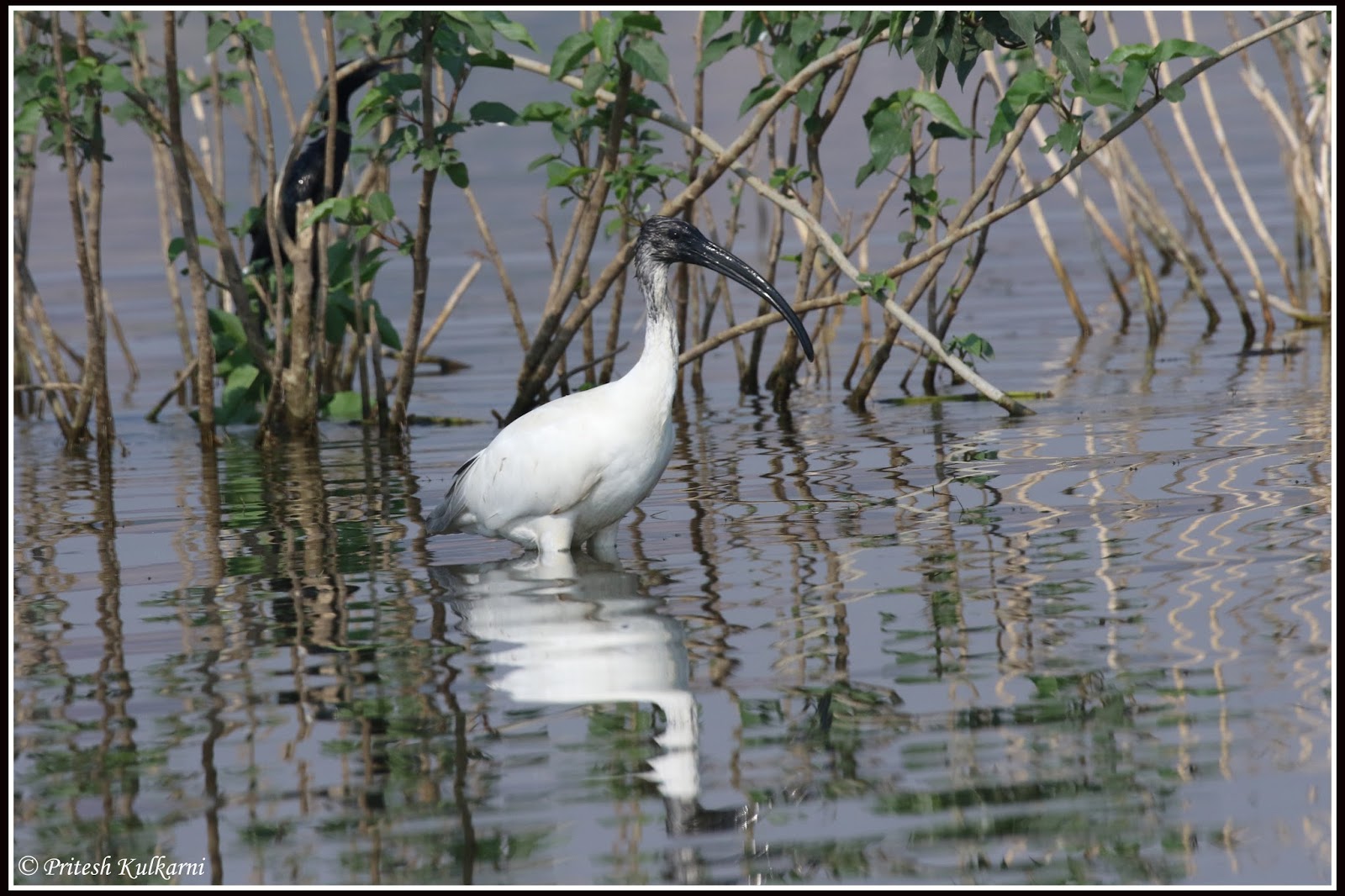
You can spot Glossy ibis, black head ibis and red napes ibis in the Bhigwan area. Ibis family is widely spread across Europe, Africa, Australia and Asia. All ibis have a long curved-down bill. Glossy ibis has a reddish brown body with glossy bottle-green wings. As the name suggests, black-headed ibis has black coloured head, neck and legs whereas white colour body. Red napes ibis is also known as Indian black Ibis or black ibis. It is large in size as compare to other ibises with the glossy dark black colour body. It has a crimson red colour patch on head.

Black-headed ibis

             Ruddy shelduck in India commonly known as Brahminy Duck. Brahminy is colour shed and word is not related to any religion/Caste. The bird belongs to Anatidae family (a family which consist of Ducks, geese and Swans). It has a beautiful orange-brown body with white, black, glossy green colour on Wings. This is migratory bird and travel to India during winter for breeding. This bird mostly found in pair or pair groups as they believe in pair bonding. It has loud honking call. Duck prefer shallow water area or found on Bank of Water bodies or inland body of water. They can fly on high altitudes along with Bar-headed Goose.

Ruddy Shelduck
            Northern shoveler is also known as Shoveler duck. It is one of the commonly found duck in Europe and Asia (Winter time). Male has a dark green head, white breast and orange-Brown body. You can see multiple colours on wings such as white, glossy green, blue and brown. Female is in drab mottled brown colour. These ducks swim in a large group. Shoveler prefers to nest in a grassy area near an open freshwater body.

Northern Shoveler

              We saw around 5-6 Bar Headed Goose in Flight.  Saw a couple of Brahmin Duck pairs busy with their breakfast and some of them were resting. We kept a safe distance and I clicked a lot of Photos. We enjoyed for half an hour observing their actions. An astonishing fact about Bar Headed Goose is that they are one of the world's highest flying birds; they migrate over Himalayas (flying higher than 21000 ft.) to spend the winter in parts of India.

Bar Headed Goose

Below are snaps were taken during my various visits to Bhigwan

Ruddy Shelduck

I'm Keeping watch on you...!!!
              Common spoonbill is also known as Eurasian spoonbill and it belongs to Spoonbill family. The bird is white in colour with a white crest. Bill is of Black colour and a yellow spot at the end of the bill. The shape of Bill is similar to spoon shape.

Spoon Bill

              The painted stork is from the stork family.  Their distinctive pink tertial feathers give them their name. This large stork has a heavy yellow beak with a down-curved tip. The head is bare and orange or reddish in colour. There is a distinctive black breast band with white scaly markings. Males and females appear alike but the males of a pair are usually larger than the female. The juveniles are a brownish plumage in colour.

Wolly necked StorkPainteded Stork
              Purple moorhen is known as western swamphen. It is a Chicken sized bird with bright purple colour and red Bill. This is native Indian Bird and can be seen on freshwater bodies across India.

Purple Moorhen

             Woolly Necked Stork belongs to Stork family. The body is in deep crimson or wine red colour with a black colour skull cap. The neck is in white colour with a soft feather which gives the name as Woolly Necked Stork. It is also called as White-necked Stork. It is freshwater wetland bird found in Asia and Africa.

Deep discussion??? Wolly necked Stork

Painted Stork

Northern Shoveler

Time to leave...

Northern Shoveler

Expenses:
  • Car Petrol: INR 1500/- (Avg INR 67/Lit, Total distance cover by car was 230km)
  • Toll on NH-09: INR 30/- (Return toll)
  • Toll 2 on NH-09: INR 50/- (Return Toll)
  • Boat ride: INR 1200/- for boat (Normal chargers are INR 1400-1600/- per boat)
  • Dinner at hotel Kanchan: INR 440/- for couple

Contact number:
  • Bharat (Boatman from Diksal): 9766292989.
  • Datta Nagare (Boatman from Kumbhargaon ): 8087767691.

I will try to upload more and more travel blogs. Thanks for reading this Travel Blog.

Pritesh Kulkarni 
Pune
Read More
  • Share This:  
  •  Facebook
  •  Twitter
  •  Google+
  •  Stumble
  •  Digg
Bài đăng cũ hơn Trang chủ

Popular Posts

  • The Best Pet-Friendly Airbnbs in California • The Blonde Abroad
    Wander the Redwood forest, take into the dramatic beauty of the desert, surf those Pacific waves, or dance the night away in Hollywood. C...
  • The Ultimate Guide to Visiting Banff National Park in the Winter • The Blonde Abroad
    Mikaela of Voyageur Tripper —a blog dedicated to outdoor adventure — is sharing her in-depth guide to Banff National Park! I’ve visited ...
  • Street markets in Vietnam
    Street markets in Vietnam: shopping in Vietnam markets Shopping lovers and street market fans will find in Vietnam their personal paradise. ...
  • Quick ride to Neelkantheshwar Temple, Pune
    Neelkantheshwar temple was on my list to visit from a long time. The distance between the  Neelkantheshwar temple and my place is around 40k...
  • Kokan paradise: Guhagar and surrounding area
               After a long monsoon break, we were ready to explore Konkan region again. I have been to this place 2-3 times before my marriage ...
  • Korea Spring 2014 - hasil shopping di Korea
    backpack comel ni sempat beli 2 je...kalau ikutkan nak beli sorang 1 untuk anak2 tapi bila memikirkan takut bag tak muat akak beli 2 je.yg c...
  • Trip Ke Hatyai dengan adik beradik - 15 Mac 2015
    Destinasi : Hatyai, Songkhla Thailand Currency Exchange : RM10 = 8.70 Thai Baht Kenderaan : Van Sewa + Driver = RM350 Salam, sementara masih...
  • Thai Spicy Larb • The Blonde Abroad
    Lauren of Create Hospitality is bringing a delicious Thai dish to the ‘Recipes Around the World‘ series! Larb is a fantastic dish that o...
  • VLOG i_am_nieta_ : Lupin at South New Zealand
  • Korea Travel Info
    Sedikit info berkaitan Korea hasil research saya : Name : Republic of Korea Capital : Seoul Currency : KRW (won) Weather : Spring  (March - ...

Copyright © Vietnam Open Touris | Powered by Blogger
Design by Hardeep Asrani | Blogger Theme by NewBloggerThemes.com | Distributed By Gooyaabi Templates